v0.1.0Initial public release

The AI workforce that
runs on your infrastructure.

Open-source, self-hosted, BYOK. Meetings become briefs, briefs become tickets, tickets become code your team reviews and ships. Your exec approves from Slack.

install
$ git clone https://github.com/workforce0/workforce0
$ cd workforce0 && docker compose up
License
MIT
Data
Self-hosted
AI
BYOK — any model
Telemetry
None
Standing on shoulders ↓Inspired by Linear, Raycast, VercelProject Graph concept: safishamsi/graphifyPrompt-caching discipline: NousResearch

The cycle

Six agents, one Chief of Staff, every decision approved by you.

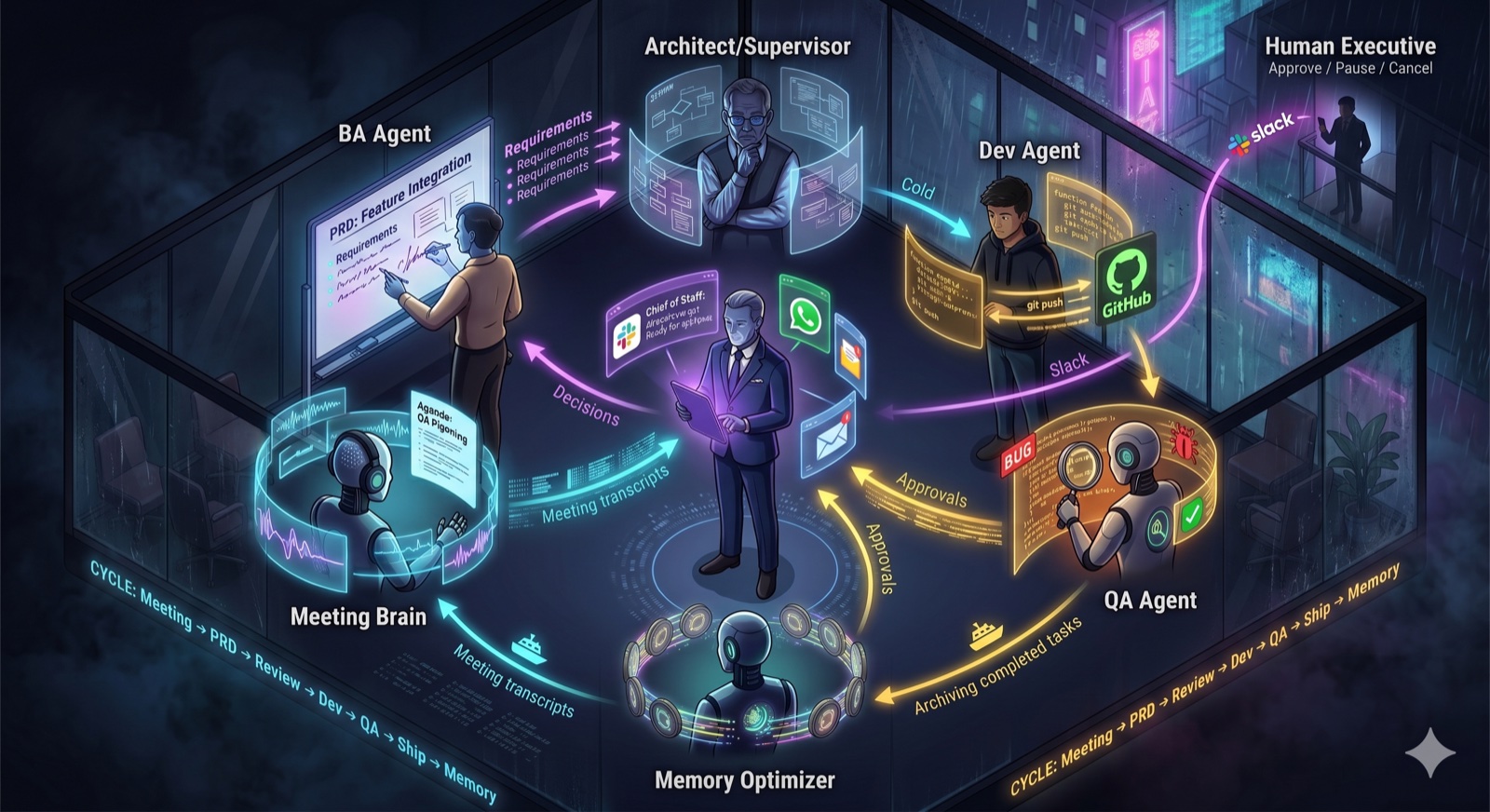
Meeting → PRD → Review → Dev → QA → Ship → Memory. The Chief of Staff posts to Slack/WhatsApp/Teams; you approve, pause, or cancel by replying.

Workforce0 architecture: Meeting Brain feeds the BA Agent, who hands a PRD to the Architect/Supervisor; Dev Agent codes and pushes to GitHub; QA Agent reviews; Chief of Staff posts approvals to a Human Executive over Slack/WhatsApp/Teams; Memory Optimizer archives the cycle.

How it works

Meeting in. Shipped work out.

Four steps. Each is observable, auditable, replayable. No black box.

  1. Capture

    Upload a recording, paste a transcript, or dial in by phone. Whisper + domain-aware prompts turn audio into structured notes.

  2. Decompose

    Chief-of-staff agent drafts a brief, asks clarifying questions, and breaks approved work into steps with roles and skills.

  3. Dispatch

    Specialist agents (BA, architect, dev, QA) pull tickets. Dev code-gen runs on your laptop via Claude Code / Cursor — source code doesn't route through our backend.

  4. Approve

    Summaries post to Slack / WhatsApp / Teams. Your exec approves with a reply. The web UI is for audit — not daily work.

Who it's for

Two audiences. One product.

Workforce0 splits setup from day-to-day use. One of you installs it. The rest of your team never touches the web UI.

For operators

Install once, hand it off.

You're comfortable with Docker, API keys, and env vars. You spin up the stack, paste BYOK keys, wire Jira / Slack / Google once. After that, the product runs itself.

  • Docker Compose, Railway, Render, Fly, DigitalOcean — pick your path
  • BYOK for Anthropic / OpenAI / Google, or local Ollama
  • Logs where you already look. No mystery boxes.
For everyone else

Live in Slack, ship in Jira.

Execs, PMs, operators. They get brief summaries in their comms channel, approve with a reply, and move on. The web UI is audit-only — they rarely open it.

  • Slack / Google Chat / WhatsApp — choose the room they already live in
  • Approve or redirect with a reply, never a form
  • Decisions are logged, nothing is lost in DMs

Features

Everything a product org runs on.

Built from the ground up as self-hosted, provider-agnostic, audit-friendly. Each feature is optional — the parts you don't turn on don't run.

Multi-model AI Council

BA agent drafts briefs through multi-model consensus across Claude, GPT, and Gemini. The planner gracefully falls back across providers. One provider down? The system keeps moving.

BYOK, no markup

Use the API keys you already pay for. No pay-per-token reselling, no hidden inference fees, no lock-in.

Comms-first workflow

Slack, Google Chat, WhatsApp — two-way reply-to-approve. Teams is one-way notifications today. The exec never opens the app; approvals happen in the room they already work in.

Integration wizards

Visual setup for Jira, Google Chat, Drive, GitHub, Twilio. Get-your-API-key buttons that open the right vendor page.

Inbound voice intake

Caller dials your Twilio number, talks to a local agent, brief lands in your queue. Three provider modes — Pipecat (local Whisper + Ollama + Kokoro), Gemini Live, or OpenAI Realtime — with deterministic fallback.

Project graph

Full TS/JS AST plus a regex-based Python extractor (Go, Rust, Java on the way). God-nodes feed the planner so decompositions target the parts of the repo that matter.

Row-level isolation

Prisma middleware enforces tenant and project scopes on every read. Audit UI shows the decision trail for every approval.

Local code-gen

The dev agent uses your Claude Code / Cursor subscription via a local daemon. Source code flows to the CLI you already trust — not through our backend.

Skills + subagents

A vendored library of playbooks and specialists the chief-of-staff can pick from. Add your own without forking.

Works with your stack

Plug into the tools your team already uses.

Every integration is optional and disabled gracefully when keys aren't set. No 'sign up to see what's supported.'

Slack
Google Chat
WhatsApp
Jira
GitHub
Google Drive
Twilio voice
Email reply

Plus local models via Ollama, vLLM, LM Studio, or any OpenAI-compatible endpoint.

Why open-source

Not a SaaS. Not a trial. Just the software.

AI platforms that capture your meetings, your decisions, and your code pipeline are too important to rent. Workforce0 is MIT-licensed software you clone and run.

Your data stays yours.

Transcripts, briefs, approvals, comms history — all live in your Postgres. We never see any of it because we don't run anything.

Your spend stays yours.

BYOK means you pay OpenAI / Anthropic / Google directly at their actual rates. No resold tokens, no monthly SaaS tier.

Your stack stays yours.

Vanilla Postgres, Redis, Node. Run it on Docker Compose, Fly, Railway, Render, DigitalOcean, or a Hetzner box. We don't own your runway.

Standing on shoulders

Where the good ideas came from.

Workforce0 is a synthesis, not an original thought. Credit where it's due.

Project Graph

The god-nodes idea, EXTRACTED vs INFERRED edge confidence tags, and the graph-based planner enrichment come from safishamsi/graphify.

Prompt-caching discipline

The 'never mutate past messages' rule that keeps Anthropic's prompt cache warm comes from NousResearch/hermes-agent.

Design language

Our 'Aperture' design system borrows heavily from the visual discipline of Linear, Raycast, and Vercel.

Open-source since 2026-04

Spin it up. See if it fits.

A fresh install on a laptop takes a couple of minutes. First brief approved in Slack: same afternoon.